Europe's Exposure to a Global Oil Supply Shock
Scale, Transmission Mechanisms, and Economic Consequences
By Jon Kelly for EuroOilWatch.com 26 April 2026
Executive Summary
A major disruption to flows through the Strait of Hormuz would rank among the largest oil supply shocks in modern history. Roughly 20 million barrels per day (~20% of global petroleum liquids) normally transit this critical chokepoint. Brent is already trading at $105.33 — up 45.3% since the late-February Middle East escalations — and any further disruption would land on a market that is already pricing in stress.
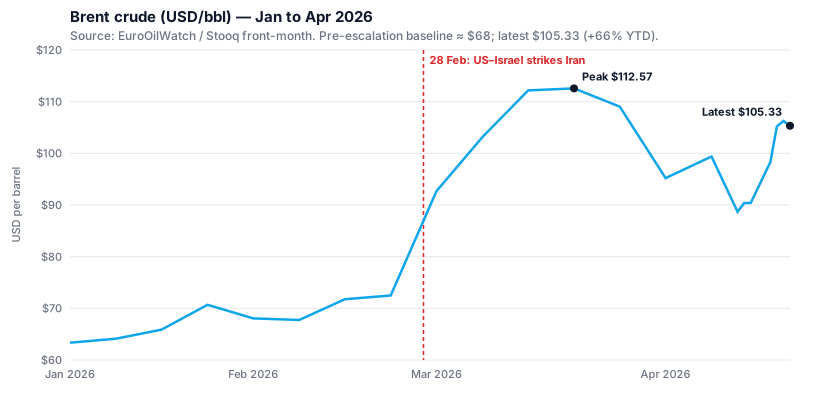
Europe will not "run out of oil" in the classic sense. However, the EU is structurally exposed to price spikes, refined-product tightness (especially diesel and jet fuel), and downstream economic pressure. The shock propagates with delay: immediate price reaction, followed by inventory drawdowns, then physical constraints in refined fuels.
The EU maintains strong emergency stocks (108.6 million tonnes per the most recently published Eurostat aggregate, fully compliant with the 90-day net imports / 61-day consumption obligation). Yet these strategic reserves are designed for short-term buffers — not prolonged refined-product squeezes or sustained global pricing pressure.
EuroOilWatch readers in transport, logistics, aviation, refining and procurement: the real risk is not a sudden continent-wide blackout but sustained higher costs and potential localised fuel availability issues that hit fleets, airlines and southern/eastern member states hardest.
1. Global Oil System: Scale and Concentration
Global oil supply runs at approximately 100–104 million barrels per day (mb/d). The Strait of Hormuz carries ~20 mb/d — about 20% of total global consumption and a quarter of seaborne traded oil.
| Metric | Value | Share |
|---|---|---|
| Global oil consumption | ~100–104 mb/d | 100% |
| Flow through Hormuz | ~20 mb/d | ~20% |
Even a partial (10–15 mb/d) disruption would be one of the largest supply shocks on record. Today's market is more diversified and financially sensitive than in the 1970s, so price transmission is faster even if physical shortages are delayed.
2. Historical Context: Lessons from Past Shocks
Previous crises shaped today's EU emergency-stock rules.
| Event | Estimated Supply Loss | Price Impact | Structural Outcome |
|---|---|---|---|
| 1973 Oil Embargo | 4–5 mb/d | ~4× increase | Creation of strategic reserves |
| 1979 Iran Revolution | 5–6 mb/d | ~3× increase | Supply diversification |
| Potential Hormuz shock | 10–15 mb/d | Severe | System-wide stress (current test) |
3. Transmission Mechanism: Why the Shock Is Delayed
Oil shocks travel in waves, not instantly.
| Phase | Timeline | Effect |
|---|---|---|
| Immediate | Days | Price spike on futures markets |
| Short-term | Weeks | Commercial inventory drawdown |
| Medium-term | 1–2 months | Physical import shortfalls |
| Longer-term | 3+ months | Demand destruction & slowdown |
Tankers already at sea, existing contracts and strategic stocks create the lag.
4. Asia: The First and Hardest Hit
Asia absorbs ~80% of Gulf exports.
| Country | % Oil Imports from Middle East |
|---|---|
| Japan | ~90–95% |
| South Korea | ~70% |
| India | ~50–60% |
Asia deploys reserves early and tightens spot markets first — setting the global price floor that Europe then imports.
5. Europe's Exposure: Reduced, But Not Removed
Europe's direct crude imports from the Gulf are lower than Asia's, yet exposure remains high through global pricing and refined-product imports.
| Exposure Type | Level | Risk |
|---|---|---|
| Direct Gulf crude | Moderate | Medium |
| Global price exposure | High | High |
| Refined product imports | High | Critical |
| Strategic reserves | 90 days net imports / 61 days consumption | Policy buffer |
5A. EuroOilWatch Reserve Picture: Days of Supply by Country (Emergency Stocks)
Under Council Directive 2009/119/EC, EU countries must hold emergency stocks equal to 90 days of net imports or 61 days of inland consumption, whichever is higher. The most recently published Eurostat aggregate puts the EU at 108.6 million tonnes of emergency oil stocks — compliant at headline level.
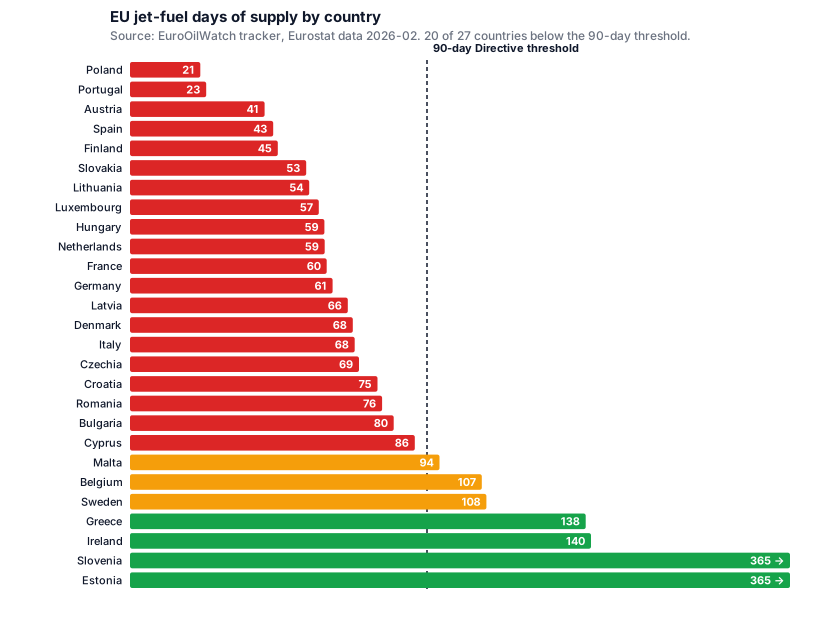
But aggregate compliance hides the per-fuel reality. The EuroOilWatch tracker — built on Eurostat monthly stock and consumption data (latest period: February 2026) — shows that 19 of 27 EU countries are currently in critical status on at least one fuel type, and jet fuel in particular sits below 90 days in 20 of 27 countries.
Correction and update, 13 September 2026. Three things about the paragraph above. The present tense was wrong to leave unqualified: these were the figures for the February 2026 Eurostat period, the latest available when this was published. On the June 2026 period now on the tracker, 24 of 27 countries are classified critical on at least one fuel, all 27 carry a jet-fuel figure, 23 of them sit below the 90-day reference and 22 are classified critical. The jet denominator was wrong even for February: Lithuania reported no jet-fuel figure for that period, so the February count was 19 of the 26 countries reporting, not 20 of 27. The EU jet-fuel average of 91.9 days cannot be reproduced from today's data: the February period in the current series averages 98.9 days across the 26 reporting countries. We have no archived copy of the series as it stood in April 2026, so we cannot say whether the 91.9 figure was an error at the time or has since been revised; it is recorded here as unreproducible rather than attributed to either cause. And the framing: the 90-day line used throughout this piece is an OilWatch reference on per-product consumption cover. Directive 2009/119/EC requires emergency stocks equivalent to 90 days of average daily net imports or 61 days of average daily inland consumption, whichever is greater, in crude equivalent across all products. Nothing here establishes compliance or non-compliance with it. The argument — that per-fuel cover is thinner than the aggregate headline suggests — is unaffected.
EuroOilWatch Days-of-Supply Tracker (Eurostat, period 2026-02)
| Country | Petrol | Diesel | Jet fuel | Avg | Status |
|---|---|---|---|---|---|
| Romania | 33.2 | 32.4 | 76.4 | 47.3 | 🔴 Critical |
| Poland | 51.8 | 71.0 | 21.3 | 48.0 | 🔴 Critical |
| Germany | 52.7 | 64.2 | 61.4 | 59.4 | 🔴 Critical |
| Portugal | 83.8 | 78.0 | 23.1 | 61.6 | 🔴 Critical |
| Spain | 83.7 | 64.7 | 43.4 | 63.9 | 🔴 Critical |
| Italy | 69.5 | 64.3 | 68.1 | 67.3 | 🔴 Critical |
| France | 64.7 | 83.4 | 59.6 | 69.2 | 🔴 Critical |
| Belgium | 69.0 | 99.9 | 106.6 | 91.8 | 🔴 Critical |
| Greece | 102.5 | 64.9 | 138.1 | 101.8 | 🔴 Critical |
| Netherlands | 86.0 | 215.7 | 59.0 | 120.2 | 🔴 Critical |
| Bulgaria | 88.9 | 80.8 | 79.9 | 83.2 | 🟠 Warning |
| Sweden | 100.9 | 113.8 | 108.0 | 107.6 | 🟢 Safe |
| Ireland | 176.6 | 128.3 | 139.7 | 148.2 | 🟢 Safe |
(Full 27-country dataset on the EuroOilWatch tracker. Days below the 90-day threshold are flagged critical for that fuel.)
Key takeaways from the live data:
- Jet fuel is the weakest link: Poland (21.3 days), Portugal (23.1), Spain (43.4), Finland (44.8), Romania (76.4), Netherlands (59.0) and France (59.6) all sit well below 90 days. EU-wide jet-fuel average: 91.9 days.
- Diesel is tighter than headline figures suggest in Romania (32.4), Slovakia (55.1) and Croatia (59.8) — directly relevant to freight, agriculture and military logistics.
- Petrol is generally the most comfortable fuel, though Romania (33.2), Lithuania (38.2) and Luxembourg (48.5) remain exposed.
- Only four countries are in safe status overall: Sweden, Ireland, Slovenia and Estonia.
EuroOilWatch method: Days of supply = emergency stocks ÷ average daily inland consumption, by fuel type. Eurostat monthly stock data, adjusted for ~10% inaccessible tank bottoms. Per-fuel days-of-supply differ from the EU Directive's aggregate metric — a country can be Directive-compliant in tonnes while still running individual fuel categories below 90 days.
Current Reserve Picture (EuroOilWatch House View)
Europe enters this shock with a stronger emergency-stock framework than many import-dependent regions — but that should not be confused with immunity.
- EU emergency stocks: 108.6 million tonnes (latest published Eurostat aggregate) — adequate at aggregate level.
- Countries critical on at least one fuel: 19 of 27 (per EuroOilWatch tracker, period 2026-02).
- Refined-product vulnerability: High — jet fuel critical in 20 of 27 countries; diesel critical in major freight economies including Germany, France, Italy and Spain.
- Recent EU coordination: At the joint Gas and Oil Coordination Groups meeting on 24 April 2026, the Commission concluded that jet-fuel supply "remains sufficient to cover demand at the moment" but warned that a prolonged closure of the Strait of Hormuz could substantially impact supply in the coming weeks or months. The Commission also launched a new EU Fuel Observatory for near real-time monitoring of crude and petroleum-product supply, stocks and trade flows, and referenced the release of stocks already committed under the IEA collective action.
The immediate question is not "How much oil is in storage?" but "How quickly can it be released, refined and delivered to the sectors that need it most?" Emergency reserves buy time. They do not instantly fix lost refinery output, missing jet-fuel cargoes or higher freight costs.
Overall assessment: Stable buffer at strategic level, weak downstream resilience. The strategic risk is a slow tightening of diesel, jet fuel, freight capacity and aviation resilience.
6. The Critical Vulnerability: Refined Products
Europe is structurally short on refining capacity for middle distillates.
| Product | Dependency Level | Key Risk |
|---|---|---|
| Diesel | High | Transport & logistics disruption |
| Jet fuel | High | Aviation vulnerability |
| Petrol | Moderate | More diversified |
Europe imports significant volumes of jet fuel and diesel from the Middle East and Asia (itself Gulf-dependent). Per Reuters reporting (21 April 2026), the EU imports roughly 30–40% of its jet-fuel needs, of which about half originate from the Middle East — meaning ~15–20% of total EU jet-fuel demand is directly Hormuz-linked. The Commission is now examining alternative sources, including US Jet A (which has a higher freezing point than the European spec) and an accelerated ramp-up of sustainable aviation fuel (SAF) and synthetic fuels, though SAF production today remains far below targets and costs up to five times more than conventional jet fuel.
7. Sector Impact: Aviation, Transport and Tourism
Aviation: High exposure. European airlines face higher ticket prices, reduced capacity and possible route cancellations.
Transport & Logistics: Diesel price/availability spikes feed directly into freight rates, food distribution and industrial costs — transmitting inflation through supply chains.
8. Geographic Impact Within Europe
Impact varies by region:
- Southern Europe (Spain, Italy, Greece): High (tourism + import reliance)
- Eastern Europe (Poland, Baltics): High (product dependency)
- Northern Europe (incl. Netherlands/Belgium refining hubs): Moderate but under pressure as redistribution hubs
9. Strategic Reality: Demand Adjustment
A shock of this scale forces adjustment through higher prices and reduced demand. The system stabilises not by magically restoring supply but by suppressing consumption.
10. Conclusion
Europe is not insulated from a global oil shock. Exposure is indirect but systemic, concentrated in refined fuels rather than crude, and amplified by global pricing.
Most likely sequence:
- Rapid price escalation
- Delayed tightening in refined markets
- Sector-specific disruption (aviation, haulage)
- Broader economic slowdown
There is unlikely to be an immediate continent-wide collapse in supply. But there is a high probability of sustained economic pressure driven by constrained fuel availability. The system does not fail instantly — it tightens and forces adjustment.
Fleet operators, airlines, refiners and procurement teams across the EU: monitor ARA diesel stocks, jet-fuel import flows and weekly EuroOilWatch updates. The next 4–8 weeks will reveal how quickly the wave reaches European forecourts and airports.
Sources
- IEA Oil Market Report, April 2026
- EIA World Oil Transit Chokepoints (1H 2025 data)
- Eurostat Emergency Oil Stocks Statistics (May 2025)
- Council Directive 2009/119/EC (oil stocking obligations)
- Reuters, EU weighs more US jet fuel, cleaner aviation amid Iran war strains (21 April 2026)
- European Commission, Gas and Oil Coordination Groups take stock of the situation on gas and oil markets (24 April 2026)